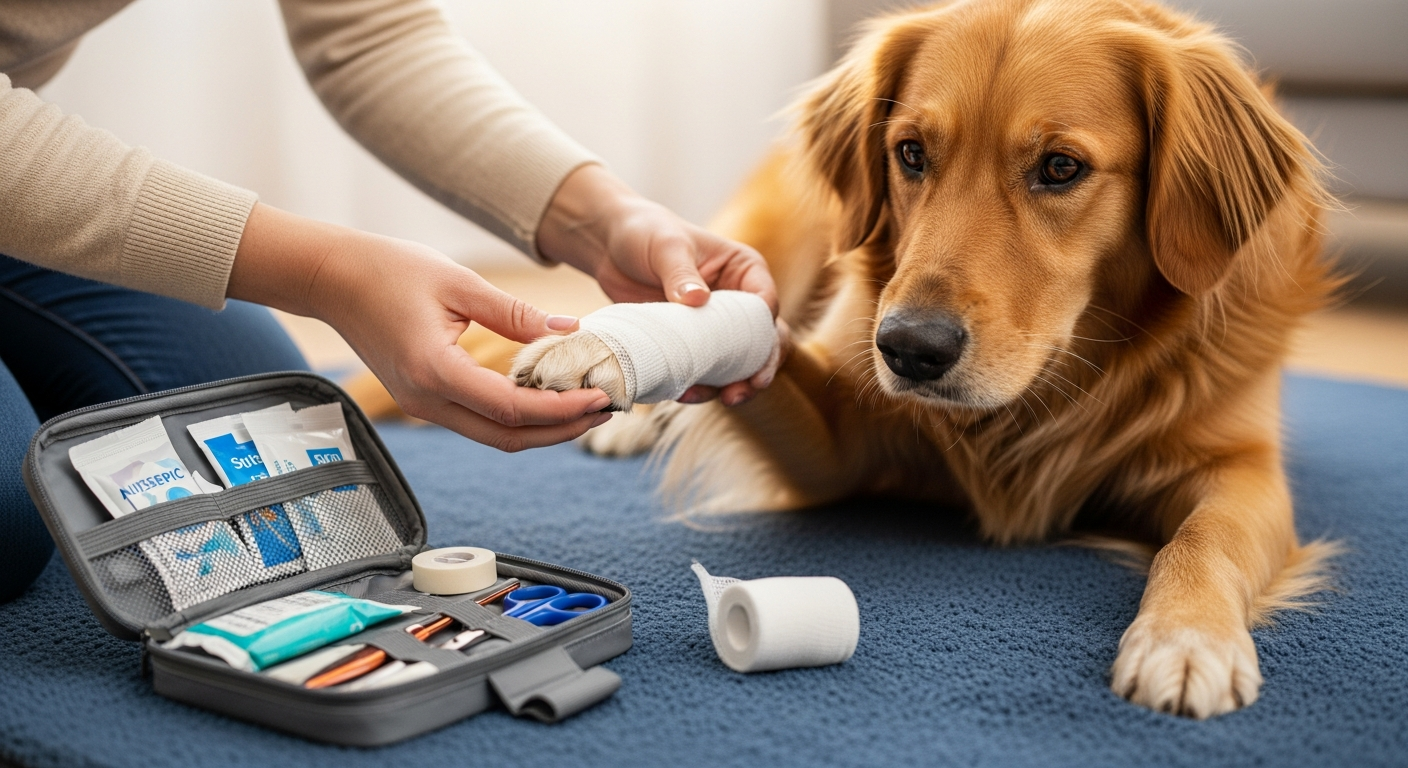
Paw pad injuries are among the most common trauma I see in emergency veterinary practice, and they are also among the most often mishandled at home. The paw pads are specialized skin that is thicker, tougher, and more heavily innervated than ordinary skin, but they are not invincible, and they heal slowly once damaged. This guide walks through the immediate first aid for the four most common paw pad injuries and the specific signs that mean a dog needs a veterinary visit rather than home care.
Seek Veterinary Care If:
- Bleeding does not stop after 10 minutes of direct pressure
- The pad is fully torn off, exposing the deeper tissue
- An object is embedded deeply (glass, thorn, nail)
- The dog refuses to bear any weight on the paw after 24 hours
- There is visible pus, swelling that spreads beyond the paw, or foul odor
- The injury was caused by a chemical burn or extreme heat
Why Paw Pad Injuries Heal Differently
The paw pad (technically the digital or metacarpal pad) consists of a thick keratinized epidermis over a fibrofatty tissue cushion. The pad does not have the same vascular supply as the surrounding skin, which is one reason even shallow lacerations bleed heavily at first but heal slowly. The dog is also walking on the injury, which mechanically re-opens it every time weight is placed. Standard wound-care principles (clean, protect, monitor) still apply, but the pace of healing is typically 2 to 4 weeks for a moderate injury, not days.
Injury Type 1: Superficial Cuts and Abrasions
A shallow cut from glass, gravel, or broken branches is the most common paw injury. It bleeds briskly but resolves with proper cleaning and bandaging. The immediate steps:
- Restrain the dog calmly. A muzzle is appropriate for dogs in pain, even normally gentle ones.
- Flush the wound with sterile saline or clean running water for at least 60 seconds to remove debris.
- Apply firm direct pressure with sterile gauze for 5 to 10 minutes. Do not peek repeatedly; it disrupts clot formation.
- Once bleeding controls, apply a thin layer of a veterinary-approved antiseptic ointment (chlorhexidine gluconate or povidone-iodine). Avoid hydrogen peroxide, which damages healing tissue.
- Bandage using the three-layer method described in our wound care and bleeding article: non-adherent contact layer, absorbent padding, and a conforming outer wrap.
Change the bandage every 24 hours for the first 3 days, then every 48 to 72 hours until healed. Watch for increased redness, discharge, or a foul odor, all of which indicate infection requiring veterinary antibiotics.
Injury Type 2: Torn Pad
A torn pad, where a flap of pad tissue has separated, is more serious. It typically happens from running on rough surfaces, sharp objects, or hot pavement. Do not attempt to trim or remove the flap; the tissue may still reattach. Clean with saline, apply light pressure to control bleeding, and bandage the paw to immobilize the flap. A torn pad often needs veterinary evaluation within 24 hours because it may require sutures, debridement, or tissue adhesive, and heavily contaminated tears need antibiotic therapy. The ASPCA's general pet first aid guidance emphasizes prompt veterinary involvement for full-thickness pad injuries.
Injury Type 3: Burns
Thermal burns from hot pavement are preventable but common in summer. Pavement temperature can exceed 140 F when ambient is 85 F, which is sufficient to cause second-degree burns within 60 seconds of contact. First aid is time-critical:
- Move the dog immediately to shaded, cool (not cold) surface.
- Cool the pads with tepid water (70 to 80 F) for 10 to 15 minutes. Do not use ice.
- Assess severity. Superficial redness with no blistering may be managed at home with aloe-based cooling gel and soft bandaging. Blistering, open skin, or pad separation requires a veterinary visit.
- Keep the dog off the injured foot for the next 48 to 72 hours using indoor rest, a cone, and short leashed bathroom breaks only.
Chemical burns (pool chemicals, antifreeze, deicer) require copious flushing with water for 15 minutes minimum, then veterinary evaluation. Do not apply neutralizing agents; they can worsen the tissue reaction.
Injury Type 4: Foreign Objects and Punctures
A thorn, splinter, or small piece of glass can usually be removed at home with clean tweezers if it is fully visible and superficial. Anything deeper, fully embedded, or not visible should be left in place and evaluated by a veterinarian. Removing a deeply embedded object at home risks leaving fragments behind, which reliably leads to chronic infection and requires surgery. Puncture wounds from wildlife bites are always veterinary emergencies because of the high infection and rabies exposure risk, and the AVMA's first aid procedures are explicit on this point.
The "Never Apply" List
Several popular home remedies can actively harm paw pad healing:
- Hydrogen peroxide. Kills the fibroblasts that rebuild tissue. Use only to induce vomiting on veterinary instruction.
- Rubbing alcohol. Toxic, drying, painful, and tissue-damaging.
- Neosporin with pain relief. Contains pramoxine, which many dogs tolerate, but the pain relief version occasionally contains ingredients problematic when ingested; plain triple antibiotic is safer.
- Superglue. Over-the-counter adhesives are not medical grade; veterinary tissue adhesives used by vets are formulated differently.
- Flour or cornstarch. Myth. Does not control bleeding and contaminates the wound.
Bandaging the Paw Correctly
A correctly applied paw bandage needs to be snug enough to stay on but loose enough to avoid cutting off circulation. Check circulation every 2 hours by pressing a nail bed; it should return to pink within 1 to 2 seconds. A bandage that is too tight will cause swelling above it and coldness below. Extend the bandage at least 5 cm above the injury and use waterproof covering during wet weather or toileting. The cone (Elizabethan collar) is non-negotiable for dogs who would otherwise chew the bandage off.
Our article on building a dog first aid kit covers the specific bandaging supplies to keep at home, and the bleeding and wounds article has the technique detail for bandaging that applies equally to paw injuries.
When to Use a Boot Instead
For partially healed paw injuries where a dog needs to go outside briefly, a veterinary boot or a clean sock secured with vet wrap provides temporary protection. Do not use boots as a primary treatment substitute for a bandage; they do not absorb exudate and do not hold a wound closed. They are for the later recovery phase, not the acute injury phase.
Preventing Paw Pad Injuries
Conditioning gradually increases paw pad toughness for dogs who hike or run on varied surfaces. Regular nail trims reduce the lever arm on toes and lower the risk of pad stress. In summer, walk on pavement only at dawn or after sunset; the 5-second test (hold the back of your hand on the pavement for 5 seconds; if it is uncomfortable for you it is too hot for the dog) is a reliable proxy. In winter, avoid salted sidewalks where possible and rinse paws immediately after exposure; deicers are irritating and many formulations contain calcium chloride, which can cause chemical burns on already chapped pads.
If your dog is recovering from a paw injury and signs of shock or systemic illness emerge, consult our shock assessment guide for next-step decision-making. For deep or heavily contaminated wounds, our wound and bleeding management article is the primary reference. For other paw emergencies such as nail fractures or foreign-body penetration through the skin, veterinary evaluation is appropriate.